Overflite
Model Hot Air Balloons - Instructions How to Build
Birthday Candle Engine Powered UFO Fire Baloons
Mathematics and Technology for Science and Design
Birthday
Candle Balloons can climb over two thousand
feet high, sail for over a mile, shine like big
orange stars and then finally burnout. It's like
having your very own rocket launch program. Like
NASA or SpaceX. Except cheaper, more fun and not so
time-consuming.
People can fly fire balloon fleets - YouTube
- Sky Lanterns - Or launch scenic location
party balloons. Or play party balloon bocce
ball or original starship
trooper. Like some filibustero
or sneaky
pete - Can launch from anywhere there is a
clear path to the sky. Balloon will then fly into
the slipstream. Through the whirlwind and into the
clear air.
-- BALLOON SCIENCE SCROLL DOWN -- or click - balloon history - balloon lift - balloon heating - balloon aerostatics -
-- BALLOON DESIGNS - Homemade Plastic
Bag Balloon - Dry Cleaner Bag Balloon - SCROLL
DOWN
= = =
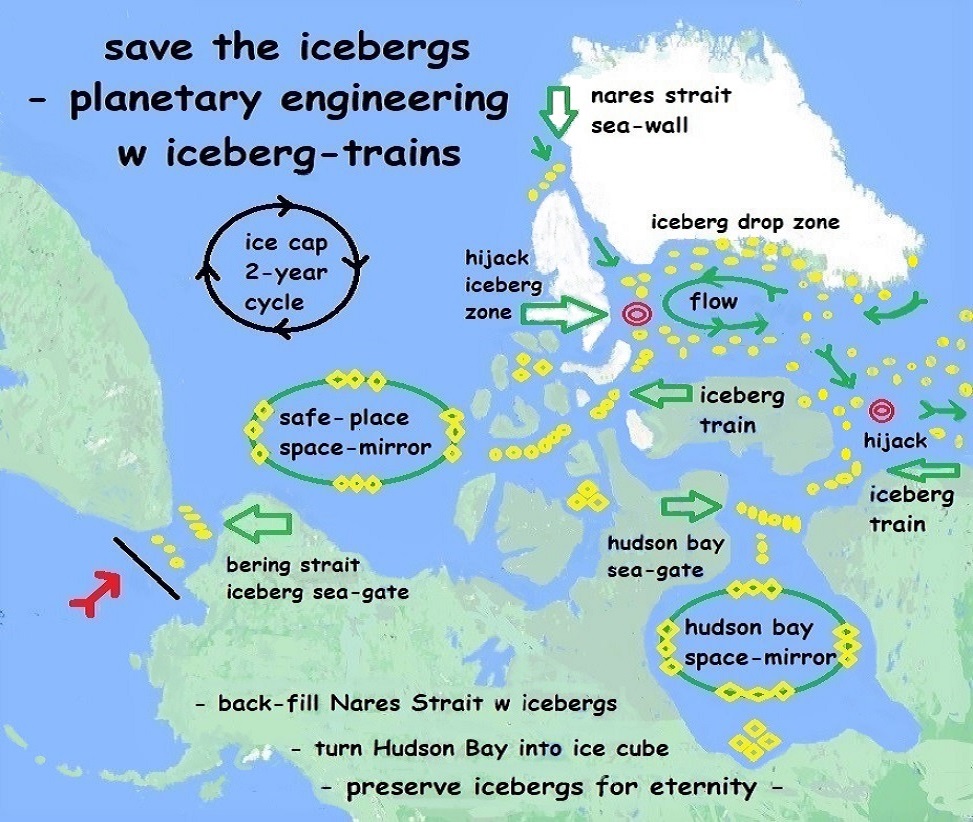
SAVE THE ICEBERGS - PLANETARY ENGINEERING - Hijack
icebergs in Baffin Bay. Tow Iceberg-Trains to
Safe-Space. Gate-Keep Bering Strait
Save the Icebergs - Save the World -
Build the Iceberg-Space-Mirror in Hudson Bay -
Build the Iceberg-Trains - Build the
Iceberg-Wall - Save the Polar-Ice-Cap
www.vikingballoon.com
www.vikingballoons.com
= = =
= = =
VIKING FUNERAL BALLOON - w Crown Design Engine -
burns up at the end to scatter the ashes
This is a concept balloon. Idea is for a paper
balloon at around 1600 cubic feet. Powered by
around 1000 birthday candles with crown engine
heating and tic-tac-toe frame. With lots of
options.
www.overflite.com/viking.html
MODEL
HOT AIR BALLOON SCIENCE
-
BALLOON LIFT - Weight of
Air Calculation, Heating and Hot Air Balloon
Lift - applies Gas Laws to model hot air
balloons.
- BALLOON HEATING - Mathematical
Models for Candle Balloon Design - builds a
system of geometric models for approximating
candle balloon heating. Suggests how many birthday
candles to use for different volumes.
- BALLOON DESIGN - Aerostatic
Design Principles for Paper Hot Air Balloons!!
-- Applies Geometry, Algebra, and Scaling, to
build formulas and methodologies for calculating
theoretical specifications for both plastic and
paper model hot air balloons.
- BALLOON VOLUME - Volume
Calculations for Cylinder Shaped Balloons
includes a table for different bag sizes. It also
describes Scaling, ie. the geometry for changes in
dimensions, volume and surface area for
equivilently shaped objects.
- BALLOON LAB - Hot Air
Balloon Laboratory -- School Science Project
Lesson Plan heats a dry cleaner bag balloon,
with a hot air popcorn popper. Measures
temperature and lift. Applies the mathematics for
Gas Laws.
- Instructions How
to Build Dry Cleaner Bag Fire Balloons.
Included are balsa wood "H-frame" balloons,
drinking straw "X-frame" balloons, and mixed
component balloons. Also included are specs for
the physical dry cleaner bags that fly. Plus list
of plastic bag supply houses. Where perhaps a
large roll contains 666 balloon bags - allotment.
- Instructions How
to Build Homemade Bag Fire Balloons. Only
balsa wood "H-frame" balloons are included so far.
Stay tuned for information on drinking straw frame
balloons. Possibly with "X-frame." Or go figure.
Since it is pretty simple anyway. Main rule being
that if the engine gets too heavy then just add
another strut!!
- Computerized
Simulation of Candle Balloon Design & Heating - Developed by
Dan Freeland from the Czech Republic.
- Central Park NYC -- Overflite's
Secret Home Base - 10106
- Mostly flew after things got quiet. Mostly from
1995 to 1999. Had some beautiful flights. Hale-Bobb
Intercept - Great Triangle in the Sky - Thread the
Needle - Take the A-Train - NE Corridor - East River
Bump - West Side Hudson - Helicopter Escort -
Reflections in the Glass - Behondo - Yankees launch
- Hells Gate launch - Richard Nixon Memorial launch
- DC Expeditionary Launch - Over 100 flights.
- History of Fire Balloons - w
Links
- Web Links -- Includes
links to various plans for building paper hot air
balloons. Etc.
NOTICE: All
Balloonists are warned that they build and fly
Fire Balloons completely at their own risk,
and that they are completely responsible for
determining all risks, and for any
consequences that result! Sky Lanterns have
been flying for almost 2000 years. People can
reasonably claim - "Flown by the Billions" -
since you can only imagine the extravaganzas
the various emporers sponsored over the years.
Plus the everyday sky lanterns for regular
holidays, important events and remembrances.
Plus all the wishes that people have flown for
too. For fun or serious. Where sky lanterns
symbolized a link between earth and heaven.
With the sky as the cathedral.
Remember,
you are completely responsible for every balloon
you fly!
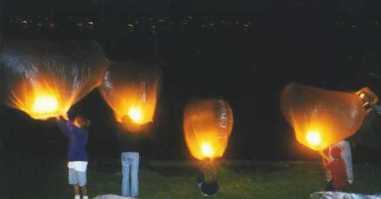
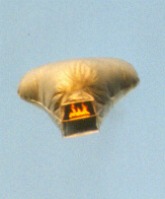
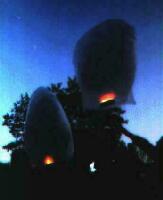
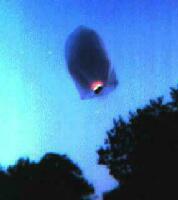
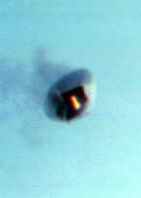
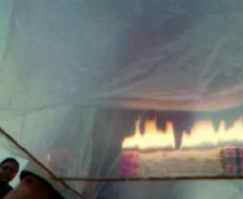
Models include Homemade Plastic Bag Balloon
& Dry Cleaner Bag -
Straw Boss Balloon ...
- Drinking straws are stuck together to make the
X-frame. Scotch tape flaps on the ends of the
straws make it simple to tape frame to bag. Engine
is pinned to frame with three shirt pins.
- Typical birthday candle engine for Straw Boss is
made with 24 of the 36/pack Cakemate candles.
Melted together with a fork. Made double-file. 12
+ 12 = 24 candles. For cold weather only!
- Alternately balsa wood sticks can be tied
together or taped together into an H-frame. -
Specifications for Pic Balloon - 15 cubic feet -
1/3 mil bag made w hot pizza-cutter - H-frame
balsa wood frame - single-file engine - w 44
candles - 24/pack type.
SEE WARNINGS - BALLOONISTS COMPLETELY RESPONSIBLE
FOR ALL FIRE BALLOONS - SCROLL DOWN FOR MORE
INFORMATION
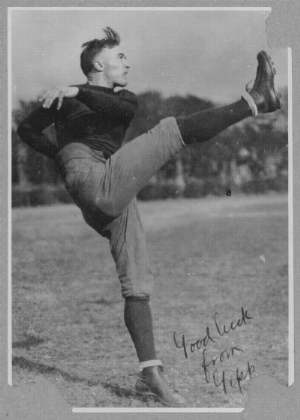
-- "Win
one for the Gipper" - CIRCA 1919 George
Gipp signed photograph was sold at auction
04/22/11. Heritage Auctions - www.ha.com
- The World's
Largest Collectibles Auctioneer - 2011
April Dallas Signature Sports Collectibles Auction.
Sports memorabilia experts say there are fewer than
10 Gipp's in the entire world. -- Find out - How many Gipps are there?
<>
Win the
Gipp - SOLD - for final realized price of $6572 - The
second greatest trophy after the Stanley Cup
........  ................
 ........ ........
Also check out -
YouTube -- Video - candle
hot air balloon - fire
balloon - ufo
balloon - sky
lantern -- Plus - SCROLL DOWN - for - SERIOUS FIRE BALLOON
INFO - Includes balloon science, theory
and design. Plus actual flying models. Includes
Straw Boss dry cleaner bag model. Plus exotics
& imaginaries & theoretical balloons. -- BALLOON REPORT
- "very peaceful
- serene - beautiful - I think we witnessed some
type of miracle"-
- - - - - - - - - - - - - -
Go for
Launch - Nowdays - It's buy and fly. Beaucoup stock
and store. Seriously cheap. Especially for balloon
bocce or fire balloon fleets. Muster motley crew of
friendly friendlies. Launch cheap flights. Like
filibustero or sneaky pete. Figure the flying
lanterns to climb into the slipstream for a five
minute one-click free flight. But it seems much
longer. Colder the better. Like a PBR. Or Dogfish
Head.
Some say... for presumed best visibility ideal
lift-off time is roughly four minutes before sunset.
Sunset sweeps upward into the sky at around 1,000
feet per minute. Afterglow is minimal. I'm not a
believer though. Think it might just be some
chimera. When it is over it is over. But not until
then. To learn about this, notice illuminated
contrails and exact time. Then know yourself quite
perfectly when the illumination disappears. Be a
good healthy camper. Victory rolls are cool too. Can
also do Google Earth from street address of launch
site. Then make a video of your launch!
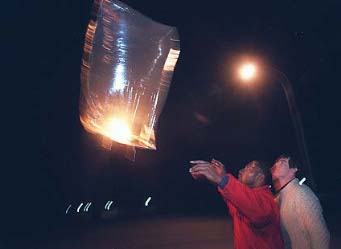
Video - wow
hot balloon - or click
here - Balloon launch model looks similar to
the overflite birthday candle balsa wood homemade
bag designs.
- What
Fire Balloons Can and Cannot Do
- - - - - - - - - - - -
- - - -
- ABC
TV News Report -- July 17, 2001 -- Strange
Lights over New Jersey - & Possible
Explanations
- 1970s
UFO Sightings -- News Article - Overflite Dry
Cleaner Bag Fire Balloons
- Police Chopper
Attacked by UFO in Kentucky -- Couple Confesses
to Launching Dry Cleaner Bag UFO Fire Balloon
--
- For
Sale: Slightly Used UFO -- Needs New Candle --
Contact the Sheriff --
- Police
Say Some UFO's are Fire Balloons with Candles
--
- UFO
Reports and Pranks Continuing...
- Homepage
for Larry Robinson -- UFO Debunker --
- National
UFO Reporting Center --Homepage -- UFO
Reports Database -- - Roswell
II? -- Reports from the Ongoing UFO Craze in
Rockford, Illinois --
- -
--Like
some unbearably hot air balloon
camp town sneaky pete copacetic paper air
force snoopy
dog camp ground lowdown showdown light-weight
flea-flicker beer belly flip-flop fogie foggy
bottom fish tidal pond water spout mall rat
swampground rat-faced dog
robber Jack & Jill. -- Then slowly holiday parade float
water back pain goose down to the three phase
neutral ground. More fun than spud gun or tennis
ball cannon barrel roll. For birthday party
ideas or music concert tour or airshow fly-by
rodeo cowboy bull lingo. Then go running track
one it and chase bank it down vest jacket. Plus
keep score too. Splash-down. Right on the money.
Hole-in-one. Bingo. Augered in. Done deed.
Bingo. Bocce ball toss up parabola buys mucho
dinero rounds of golf club balls and cocktail
fruit drink special situations. Parade float
boat and passenger ship. Music player video
revolution. Revolutionary soldier camping tent.
Beans and bacon. Down under the radar. Bike by
touring bicycle wheel. Roll over the national
international cheerleading squad. Global
competition brigade. Titanic titan or Alexander
or sneaky Peter the Great. Up against the wall
decor sword of the xenomorph. Without ceremony.
By virtue of the authority. Fly like an eagle.
Free freedom bird nest airline. Five by five.
Bronco billy club jack. Clausewitz or Sun Tzu
ground or Machievelli or Galileo telescope. War
protest. Newt Gingrich 2012. Sarah Palin 2012.
Christine O'Donnell 2012. Zeus Olympus Olympics
Olympiad. Jupiter or Apollo project or Saturn
booster rocket or Mercury space capsule or
Gemini spaceship capsule. Hit Homer or Aesop
fable about or sly fox or black crow or tortoise
or turtle or american eagle or billy goat or
sheep or sheeple horse salamander or frog man
mouse a lion a wolf pack. Chicago Eu Spain
Mexico Greece Potomac UK Germany Russia. Get
higher higher education standards.
LAUNCH IDEAS
-- Check weather
- for ambient temperature - wind speed & wind
direction - google nyc zip code - 10106
weather hour by hour NOTE - Wind direction
is where the wind comes from. North by North-West
is written NNW. Balloons
travel in the exact opposite direction - South by
South-East - SSE.
-- Large friendly crowd
is always good. Lighted utility candles might help
camouflage launch and provide good visual effect.
Always remember to act super-friendly with any
higher ups. To help give the balloons time to
escape.
-- FOR FASTER LIGHTING
& HEATING - High-temperature blowtorch-type
lighter might help speed up the lighting of the
fuel cell. Faster the better.
-- BUY CHEAP TORCH
LIGHTER FROM SMOKE STORE - $5 - To pre-heat
lantern, a birthday candle "torch" might work too.
Who knows? Wrap 24+ birthday candles in
rubberband. Then drip layers of wax onto the
candles to hold them together. Build out the sides
real thick to slow down the sides from melting
away. Can make the torch double or even triple
high to last longer. Can also make a special torch
holder out of cardboard and masking tape.
-- To pre-heat lantern,
a can of sterno might work okay. Plus possibly to
help light fuel cell too. Can wear glove and tape
masking tape all around can so it does not get too
hot to handle.
-- Heat Funnel Sterno
Battery can be made with corrugated box. Plus
sterno for heating. Shape the flaps at the top
into a pyramid. Tape top together with masking
tape to make heat funnel. Guess a six inch opening
is reasonable. Cut or tear air vents at bottom to
let air in. Heat with four to six can sterno
battery.
NOTES - Sterno is the
only reasonably safe way I have ever been able to
think of to make a Heat Funnel Sterno Battery. To
pre-heat serious balloons. Sterno is very
expensive. Most importantly it heats with a
separate low flame for each can. Which is good.
Most of the other ideas are not very good.
Especially bad is either a high flame or that
enable the flames to combine into a super-flame.
Flammable liquids are also mostly bad. Even close
to 100% isopropyl alcohol. Because the flame tends
to get too big. Plus the flame is close to
invisible. Other possible ideas include charcoal
or some type of super-candle. Or some formula for
DIY sterno. Also... Camping stoves are generally
somewhat weak sources of heat. IMHO. But might
work OK. Don't know. Also, if you insist on
alcohol, 100% only. NO water. lol. Plus some type
of splash pan might work ok. Guessing. Like a
super-sized large piece of aluminum foil. Reason
why is IF the latent alcohol quickly disappears.
Otherwise you invite yourself a fireball. Or
thunderball. Seriously. Remember dumb ideas are
bad.
- - - - - - - - - - - -
-
Can also play with
terminology. Especially for group launches or
flashmobs. Back and forth between launch
commanders and ringleaders and crowd - google - youtube
apollo 13 go for launch
"Apollo 13 Flight
Controllers - Listen up - Give me a go or no go
for launch" - Q - "...Are you go?" - A -
"We are go - fly." - "We are go for launch." - or
- "We are no-go - chill - wait a minute"
Then later post-launch - "We have lift-off" -
"Rocket is go" -- Plus other pseudo and pretend
aeronautic and rocket talk - "On my mark" - "We
have rocket" - "We have balloon." - "Roger that."
- "Going ballistic" - "Right up the middle." - "In
the profile." - "We are in the pipe - five by
five." - "Rough air ahead - we're in for some
chop." - "We are on an express
elevator to hell - going down." -
- - - - - - - - -
Great quotes
- Alien - "Has anyone ever mistaken you for a
man?" - A - "No, you?" - - "What do you mean they
cut the power? - How could they cut the power? -
They're animals." - "Let's just bug out and call
it even, okay?"
Great quotes - Winston
Churchill - "If we fail, then the whole
world... will sink into the abyss of a new Dark
Age, made more sinister... by the lights of
perverted science."
Great song
- Culture Warriors - Amendment
X - "Wake up and take a stand - They are
stealing our freedom across the land - Wake up -
Can't you see? - Our freedom is not what it used
to be -
Great
song - Grateful Dead - Brown
Eyed Women - Sing!
- "Tumble down shack in Bigfoot County - Snowed so
hard that the roof caved in - Delilah Jones went
to meet her God - and the old man never was the
same again - Daddy made whiskey and he made it
well - cost two dollars - burned like hell - I cut
hickory just to fire the still - drink down a
bottle and you're ready to kill" -
Great song - Jimmie Rodgers - Away
out on the Mountain - 1927 - "Where the
whipporwills sing me to sleep at night - and the
eagle roosts on the rocks of spontane" -
Great song
- Gonna
be a Showdown - ELO - Electric Light Orchestra - Every dream in her
heart was gone - - Heading for a showdown -
Great poem
- The
Raven - Edgar Allen Poe - Let my heart be still
a moment - - And this mystery explore - - 'Tis the
wind and nothing more -
Great poem - Rime
of Ancient Mariner - Samuel Taylor Coleridge -
The selfsame
moment I could pray - - And from my neck so free -
- The Albatross fell off, and sank - - Like lead
into the sea -
- - - - - - - - - - - -
-
HISTORY in WEST
Paper
and wax fire balloons have a long history in the
West. Going back to the Montgolfiers in 1783. The
French thought of balloons as a transformative
tool for human thought. Per typical French Deist
thinking. Especially during the Balloon
Craze Period. Yeah, let's forget about God.
Let's worship balloons instead.
The French Revolution
Period from 1789 to Napoleon's final defeat in
1815 was a time of big ideas. Some good. Some
horrible. As expressed by Percy Shelley, who flew
protest balloons over London Town in around 1812.
He wanted the Brits out of Ireland. So he flew
fire balloons to protest. Meanwhile lots of other
people were flying fire balloons too. With their
own pseudo-ideas and declarations. "This
balloon..."
Sonnet - To a Balloon,
Laden with Knowledge
by Percy Bysshe Shelley - (1812)
Bright ball of
flame that thro the gloom of even
Silently takest thine etherial way
And with surpassing glory dimmst each ray
Twinkling amid the dark blue Depths of Heaven
Unlike the Fire thou bearest, soon shall thou
Fade like a meteor in surrounding gloom
Whilst that unquencheable is doomed to glow
A watch light by the patriots lonely tomb
A ray of courage to the opprest & poor,
A spark tho' gleaming on the hovel's hearth
Which thro the tyrants gilded domes shall roar
A beacon in the darkness of the Earth
A Sun which oer the renovated scene
Shall dart like Truth where Falshood yet has been
There are several other documented practical uses
for the fire balloons in political and military
history. First with the original Chinese inventors
and others for military communications. Including
the conquest of Taiwan. To communicate between
paramilitary in mountainous terrain. Now a
national symbol and festival. Second to signal the
start the failed Nagpur Revolt. Though the
balloons never flew. Because the ringleaders got
caught. Third was by the French Resistance. Who
reportedly flew fire balloons against enemy
troops. Which the enemy might have tried to shoot
down. Followed up by cat and mouse - ditch the
cops - don't get caught - Blows
Against
the Empire.
RISE & FALL of
the ORIGINAL MONTGOLFIER PAPER BALLOONS
- Paper Fire
Balloons remained popular in the West throughout
the 19th Century until around the Great
Depression. Or even past WWII in some places in
the US. Also known as Fourth of July Balloons. But
they didn't last. And got replaced in the popular
imagination by The
Airplane - Also think they might have been
popular in bohemian circles. And that people in
Paris liked them a lot. Especially to cap off the
evening.
As described by Julie
White in Peoria IL - The First Forty Years - "The automobile
displaces the horse and buggy, while in the sky
Fourth-of-July fire balloons floating over the
city give way to airplanes."
Some old people still
remember them. Though mostly likely only as a
vignette. Since they would have been so young back
then. And have not likely thought much about it
since then. Until something reminds them. Ask
them! But also the tradition has been kept alive
throughout Latin America and in various places in
Italy and Greece and elsewhere. So some travelers
would become familiar about them through original
experience.
Ray Bradbury wrote the
"Martian Chronicles" in 1948. Apparently fire
balloons are scheduled to fly on Mars in 2033. To
communicate with the last living Martians.
Otherwise Bradbury describes "The
Fire Balloons" from 1925.
"You rarely see them
these days, though in some countries I hear they
are still made and filled with warm breath from a
small straw fire hung beneath. But in 1925
Illinois we still had them, and one of the last
memories I have of my grandfather is the last hour
of a Fourth of July night 48 years ago when
Grandpa and I walked out on the lawn, lit a small
fire and filled the pear-shaped red-white-and-blue
striped paper balloon full with hot air, and held
the flickering bright angel presence in our hands
- a final moment in front of a porch lined with
uncles and aunts and cousins and mothers and
fathers - and then very softly let the thing that
was life and light and mystery go out of our
fingers up on the summer air and away over the
beginning-to-sleep houses among the stars as
fragile, as wondrous, as vulnerable, as lovely, as
life itself."
= = = = = = = = = = = = = = = =
OVERFLITE MODEL HOT AIR BALLOONS
Traditional
Paper Fire Balloons or Montgolfiers (In Italian)
- have been flying ever since the invention of the
manned hot air balloon, by the Montgolfier Brothers,
in 1783. In the United States they were known as Fourth
of July Balloons and were part of American
Folk History, of the 19th and early 20th Centuries.
Likewise, fire balloons are also a part of World
History.
--------------------------------
People still fly paper fire balloons in a number
of places around the world, mainly for Festival of
Lights Celebrations. In Brazil
- (2)
people balloons fly in June. In Italy people
balloons fly in September. In Greece
people fly balloons for Easter. In Buddhist
countries people fly balloons in October, to
celebrate Buddha's return from Heaven and to light
the path from heaven to earth.
During World War II French Resistance Fighters
apparently launched paper fire balloons. In
French, "Foo" means either fire or fool. Many of
the Foo
Fighter Sightings - (2)
seem a lot like fire balloons too. Also, on
February 25, 1942, it seems a Japanese submarine
might have launched hydrogen balloons, with flares
attached, to trigger The
Battle of Los Angeles.
Dry cleaner bag fire balloons were also inspired
by Kenneth
Arnold's 1947 UFO Sighting. They were then
popularized by Popular Science Magazine
instructions how to build miniature hot air
balloon with dry cleaner bag, wire, cotton and
lighter fluid. Here
is a first-person account of one of those early
UFO balloons. Meanwhile enterprising young
inventors invented the birthday candle balloon
too. And inventors are still inventing the
birthday candle balloon today.
See
- Youtube birthday candle balloons - Most of
these balloons are knuckle-scrapers. But show a
lot of devotion and love.
Fire Balloons! Materials,
Construction and Design
Classic dry cleaner bag balloons are
made with thin half-mil "dress bags," 4 1/2
feet tall, weighing 6/10th of an ounce. Taller
half-mil bags also work, but are hard to find.
Nowdays most dry cleaner bags are 3/4 mil thickness,
and weigh too much to fly. Sometimes hobbyists tape
two dry cleaner bags together to make a larger bag.
In warm weather, dry cleaner bag balloons tend to
hover at first, with very little net lift. At high
elevations, dry cleaner bag balloons may not fly at
all.
"Large Envelopes," in different sizes and
shapes, can be made with thin plastic sheeting.
Look for 1/3 mil (8 micron) high-density
plastic sheeting. Welds are made with a heated
pizza cutter, on top of a wooden board. It
is amazing how well this system works!
Scotch tape repairs any weak spots.
IMPORTANT - To stabilize the balloons, the bags
are tapered, and small ventilation holes are made.
This provides "negative draft," which helps
to reduce the de-stabilizing effects of "billowing."
"H-Frames" are made by tying three balsa
wood sticks together with string. The "H-Frame"
and balsa wood design is more advanced than the
traditional X-frame. Since the two sides help keep
the bag away from the frame. But the H-frame does
not adapt very well to drinking straws.
"X-Frames" are ideally suited to drinking
straws. They can be made by sticking drinking
straws into each other, and pinning two sets
together with a shirt pin.
Engines are made by melting birthday
candles together with a heated fork.
Alternately, dripped wax can melt the candles
together. The most efficient engines are single-file.
They get maximum oxygen and cooling area. To
conserve space, engines can also be made double-file.
Here two single-files are melted together. Melted
wax holds the engine to the frame.
Technologically advanced balloonists can apply
the information to design large volume Christmas
Candle Balloons, or Homemade Candle Balloons,
which can burn for around forty minutes. Candle
Powered Paper Hot Air Balloons can also be
designed. For more detailed information on design
and construction -- Stay tuned!
NOTE: For any type of experimental fire balloon,
it is not a good idea to rely too much on an
outside heat source. Otherwise a too-heavy balloon
might climb up at first, then land, risking a
crash and burn.
------------------------------------
Fire Balloons! Warnings and
Cautions:
Once a fire balloon
gets launched it becomes completely
uncontrollable. It can't be recalled. Fire...
flying through the sky. You had better hope it
has a successful flight. If it crashes and
starts a fire and the police get involved then
it is important to confess. Since it can only
get worse if the police have to track you down.
But balloons that crash in trees that go out?
Forget about it. Also to remember that the sky
does not catch on fire. So hope the balloons go
up really really high. Then burn out. Then they
are safe. Since nothing happened.
People under eighteen years old should have parental
permission to fly powered model hot air balloons.
Remember that fire balloons might be considered to
be fireworks, and potential fire hazards. Do not use
any fuel that does not easily blow out.
Do not fly fire balloons in any fire danger
areas, especially if they are hilly or
mountainous, or if it is windy or gusting. Do not
fly any faulty or damaged fire balloons. Avoid
Crash and Burns. Balloonists are obligated
not to cause any fire danger. Also, fire balloons
should not be made too large, in case they land
directly in automobile traffic.
The FAA prohibits operating any "Unmanned
Free
Balloon" in a hazardous manner, per FAA-DOT
101.7 - The FAA also prohibits including any
significant amounts of metal, on devices
that fly to altitudes where there may be aircraft.
Do not fly wire frame fire balloons. They can be
dangerous to turbine engine aircraft. They can
also short-circuit electrical power lines.
Do not fly fire balloons near airports.
Especially avoid active takeoff and landing
patterns. Avoid flying fire balloons near any
other prohibited or restricted areas without
permission, as appropriate, unless it is very late
at night -- and doesn't matter.
Build flightworthy balloons, according to the
conditions. Avoid flying fire balloons in winds
above ten miles per hour, especially if gusting.
Avoid damaging balloons or crashing them into
obstacles. Avoid antagonizing the police or
neighbors. Monitor the complete flight of every
balloon. Be responsible, and use good judgement. Try
to make every flight a success!.
As long as candle powered fire balloons don't
crash and burn, there is not a big fire danger.
The plastic bag does not appear likely to become a
serious hazard either, as long it isn't very large
and it doesn't land directly in automobile traffic
-------------------------------------.
Fire Balloons launch best at sea level, in cool
weather, with very little wind and no strong gusts.
For local wind speed, visit YAHOO WEATHER.
The calmest weather is generally early evening, late
evening and dawn. At sunset and dawn, the red of the
sun can make the balloons shimmer. For group
launches try three balloons. "Best of Sights, Overflight."
By Thomas Taylor -- balloons@overflite.com
= = = = = = = = = = = = = = = =
-- Ron Paul - State of Republic Address - 1/22/10 -
Ron Paul Warns of Coming Social and Political Chaos
- here
- Part 3 of 3 - 3:00 minutes -
"... Dangerous
times indeed. What can be done about it? Must we
wait for the inevitable and expect to restore our
liberties in a streetfight
against the overwhelming power of the state? Not a
good option ... Liberty ... Freedom ... An all
powerful state is the threat to that ideal ... ".
-- Mick Jagger -- Well then what can a poor
boy do? Except to sing for a rock and roll band.
Cause in sleepy London Town there's just no place
for a street
fighting
man.
---------------------------
-- Hudson -- That's it man, game over man,
game over! What are we gonna do now? What are we
gonna do? --
-- Burke -- Why don't we build a fire, sing a couple
of songs! Why don't we try that? --
-- Hudson --17 days?! - (until rescue ship arrives)
- Hey man, I don't want to rain on your parade, but
we're not gonna last 17 hours against those things!
--
-- Ripley -- Hudson! This little girl (Newt)
survived longer than that with no weapons and no
training. -- Hudson- Why don't you put her in
charge? --
-- Ripley -- I
feel like kind of a fifth wheel around here, is
there anything I can do? --
Apone -- I dunno, is there anything you can do?
---------------------------
Hijack
- Blows Against the Empire - Jefferson Starship
- 1970 - lyrics
You know - a starship circlin in the sky - it
ought to be ready by 1990
They'll be buildin it up in the air even since 1980
People with a clever plan can assume the role of the
mighty
and HIJACK THE STARSHIP
Carry 7000 people past the sun
And our babes'll wander naked thru the cities of the
universe
Cmon
free minds, free bodies, free dope, free music
the day is on its way the day is ours
---------------------------
Abraham Lincoln - (1809 - April 15, 1865)
-- Public sentiment is everything. With public
sentiment, nothing can fail; without it, nothing can
succeed.
-- If destruction be our lot, we must
ourselves be its author and finisher. As a nation of
freemen, we must live through all time, or die by
suicide.
-- If General McClellan isn't going to use his
army, I'd like to borrow it for a time.
-- All the armies of Europe, Asia and Africa
combined, with all the treasure of the earth (our
own excepted) in their military chest; with a
Buonaparte for a commander, could not by force, take
a drink from the Ohio, or make a track on the Blue
Ridge, in a trial of a thousand years.
-- Whenever I hear anyone arguing for slavery
I feel a strong impulse to see it tried on him
personally.
-- This nation, under God, shall have a new
birth of freedom. Government of the people, by the
people, for the people, shall not perish from the
earth.
-----------------------------
NOTE: Mary Shelley created Frankenstein in the
summer of 1816, in Switzerland, when she was 18
years old. This was Volcano Summer 1816. When winter
never left. Meanwhile her housemate, Lorn Byron,
created Dracula. Thereby creating two of the
greatest characters in science fiction and horror.
As one of the great crowning achievements in
literary history. Literally inventing both genres at
the same time.
Meanwhile her brand-new husband Percy Bysshe
Shelley was also famous as a great poet. Previously
he flew fire balloons over London Town. This was in
around 1812, when he was 20 years old. To protest
English colonial rule over Ireland. Apparently he
also attached sheets of his own writing. Some might
have been banned. Shelley apparently also enclosed
sheets of writing in bottles. Then presumably
floated them away or left them in places where they
were likely to be found by friendlies. This was a
common method of protest at the time.
At the time Europe was recovering from the
after-effects of the 1789 French Revolution. Which
caused chaos, class warfare and civil war for
several years. This lead to Napoleon. Who conquered
most of Northern Europe at one time or another.
Until he was finally beaten for good in 1815. One
year prior. This 25 year disruption largely ended
feudalism in Europe. Which was characterized by most
of the people living as peasants or serfs. People
were henceforth emancipated. And were free to live
their lives as they chose. This was also the start
of the industrial revolution. People visualized new
societies and wondered what they would look like and
how they would be created. It can be said to be the
beginning of the modern age. Which was characterized
by the rise of both industry and the nation-state.
Most notably the independence of the nations of
Germany and Italy in around 1870.
-- Percy
Bysshe Shelley - (1792-1822) -- A poet is a
nightingale, who sits in darkness and sings to cheer
its own solitude with sweet sounds. -- Love is free.
To promise for ever to love the same woman is not
less absurd than to promise to believe the same
creed. Such a vow in both cases excludes us from all
inquiry.
-- A man, to be greatly good, must imagine
intensely and comprehensively; he must put himself
in the place of another and of many others; the
pains and pleasures of his species must become his
own.
-- When my cats aren't happy, I'm not happy.
Not because I care about their mood but because I
know they're just sitting there thinking up ways to
get even. -- First our pleasures die - and then our
hopes, and then our fears - and when these are dead,
the debt is due - dust claims dust - and we die too.
-- Only nature knows how to justly proportion to the
fault the punishment it deserves.
-- Mary
Wollstonecraft Shelley - (1797-1851) --
Invention, it must be humbly admitted, does not
consist in creating out of voice, but out of chaos.
-- The same energy of character which renders a man
a daring villain would have rendered him useful in
society, had that society been well organized.
-- How dangerous is the acquirement of
knowledge and how much happier that man is who
believes his native town to be the world, than he
who aspires to be greater than his nature will
allow.
-- If our impulses were confined to hunger,
thirst, and desire, we might be nearly free; but now
we are moved by every wind that blows and a chance
word or scene that that word may convey to us.
-- No man chooses evil because it is evil. He
only mistakes it for happiness, the good he seeks
.
-- Life and death appeared to me ideal bounds,
which I should first break through, and pour a
torrent of light into our dark world. -- I saw
the hideous phantasm of a man stretched out, and
then, on the working of some powerful engine, show
signs of life, and stir with an uneasy, half-vital
motion.
-- What terrified me will terrify others. And
I need only describe the spectre which had haunted
my midnight pillow.
-- I beheld the wretch - the miserable monster
whom I had created.
-- Frankenstein
- The Modern Prometheus - (1818) -- Once
I falsely hoped to meet the beings who, pardoning my
outward form, would love me for the excellent
qualities which I was capable of unfolding.
-- I have love in me the likes of which you can
scarcely imagine and rage the likes of which you
would not believe.
-- Satan has his companions, fellow-devils, to
admire and encourage him. But I am solitary and
detested.
-- If I cannot inspire love, I will cause
fear! -- Beware - for I am fearless, and therefore
powerful.
-- Devil, do you dare approach me? And do you
not fear the fierce vengeance of my arm wreaked on
your miserable head?
-- With how many things are we on the brink of
becoming acquainted, if cowardice or carelessness
did not restrain our inquiries?
-- He is dead who called me into being. When I shall
be no more the very remembrance of us both will
speedily vanish.
-- Mary Wollstonecraft Shelley -- The giant now
awoke. The mind, never torpid, but never rouzed to
its full energies, received the spark which lit it
into an unextinguishable flame. Who can now tell the
feelings of liberal men on the first outbreak of the
French Revolution. In but too short a time
afterwards it became tarnished by the vices of
Orléans — dimmed by the want of talent of the
Girondists — deformed and blood-stained by the
Jacobins.
-- Winston Churchill - "What General Weygand called
the Battle of France is over. I expect that the
Battle of Britain is about to begin. Upon this
battle depends the survival of Christian
civilization. Upon it depends our own British life
and the long continuity of our institutions and our
Empire. The whole fury and might of the enemy must
very soon be turned on us now. Hitler knows that he
will have to break us in this island or lose the
war. If we can stand up to him, all Europe may be
free and the life of the world may move forward into
broad, sunlit uplands. But if we fail, then the
whole world, including the United States, including
all that we have known and cared for, will sink into
the abyss of a new Dark Age, made more sinister, and
perhaps more protracted, by the lights of perverted
science."
--------------------------------------
Summary - When riding a motorcycle too fast into a
hairpin turn there are basically two strategies
about what to do to avoid possible injury and death
and destruction.
Risky Strategy - Go over the top - Speed up
and drop down into the turn and hope you don't hit
sand or gravel or the rail or fence or curb or
ditch. If the bike crashes it will typically flip
over in the opposite direction and fling the rider
high into the air at high speed. It is a very
dangerous strategy. But does sometimes avoid
crashes. By the amazing ability of the expert rider
to manouver a high speed turn. But the crashes are
very spectacular and deadly too. Typically both the
bike and rider get completely destroyed. This is
what the Obamian
Administration is doing right now.
Conservative Strategy - Prepare to drop the
bike - Slow down for the crash as much as possible
while still trying to make the turn and find an
opportunity. Then do everything possible to defend
against the crash. Typical move is to lay down the
bike in towards the turn and then try to ride the
bike like a sled for as long as possible. Then to
try to treat getting thrown off the bike like it is
some kind of great leap forward. And live to fight
another day. Possibly with a reasonably undamaged
bike too. This is what the Republicans and Tea Party
is proposing to do. For America to survive. It is
also the less dicey strategy of the two. And with
greater promise for long-term success.
--------------------------------------
-- Tacitus -- A shocking crime was committed on the
unscrupulous initiative of few individuals, with the
blessing of more, and amid the passive acquiescence
of all.
-- Maximilien
Robespierre -- The secret of freedom lies in
educating people, whereas the secret of tyranny is
in keeping them ignorant.
-- Napoleon Bonaparte -- When small men attempt
great enterprises, they always end by reducing them
to the level of their mediocrity.
-- Leon Trotsky -- England is nothing but the last
ward of the European madhouse, and quite possibly it
will prove to be the ward for particularly violent
cases.
-- Saul
Alinsky -- An organizer must stir up
dissatisfaction and discontent ... He must create a
mechanism that can drain off the underlying guilt
for having accepted the previous situation for so
long a time. Out of this mechanism, a new community
organization arises ... The job then is getting the
people to move, to act, to participate; in short, to
develop and harness the necessary power to
effectively conflict with the prevailing patterns
and change them.
= = = = = = = = = = = = = = =
Rime of the Ancient Mariner
- By Samuel Taylor Coleridge - 1796 - Excerpt
Beyond the shadow of the ship
I watched the water-snakes
They moved in tracks of shining white
And when they reared, the elfish light
Fell off in hoary flakes.
Within the shadow of the ship
I watched their rich attire:
Blue, glossy green, and velvet black,
They coiled and swam; and every track
Was a flash of golden fire.
O happy living things! no tongue
Their beauty might declare
A spring of love gushed from my heart,
And I blessed them unaware
Sure my kind saint took pity on me,
And I blessed them unaware.
The selfsame moment I could pray;
And from my neck so free
The Albatross fell off, and sank
Like lead into the sea.
= = = = = = = = = = = = = = = = = =
--Made by Identified
Flying Objects Ltd (IFO)
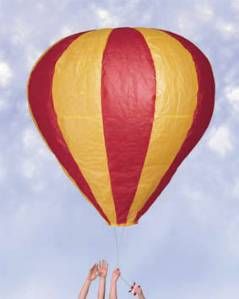
"Best of
Sights, Overflight"
|
www.overflite.com
balloons@overflite.com
-
-
-
-
-
-
|